
Two production routes, different sources of value
| Question | AI UGC-style production | Human creator production |
|---|---|---|
| Where does the message come from? | An approved script and supplied references | A brief plus a person’s performance and observations |
| What is captured? | Generated presenter or visual material | Real footage of the person, product and action |
| What changes during revision? | Script, inputs, model settings and the edit | Edit decisions or a new recording when needed |
| What does the purchase buy? | Software access and metered production capabilities | An agreed creator service and deliverables |
| What can it establish? | A visual explanation of supported claims | Actual use or experience when genuinely documented |
| What remains uncertain? | Accepted output and campaign performance | Accepted output and campaign performance |
These are production distinctions, not universal claims about speed, trust or conversion. Individual offers and briefs vary.
Define what you mean by UGC
The term UGC is used for several kinds of content: unsolicited customer posts, commissioned creator videos and AI-generated ads that imitate a casual creator format. Those categories can look similar in a feed while having different sources and production processes.
For a purchasing decision, describe the deliverable plainly. Do you need a person to try the product and explain their experience, or a presenter to communicate an approved feature? Do you need original footage, an edited ad or both? Clear language prevents a comparison between services that solve different problems.
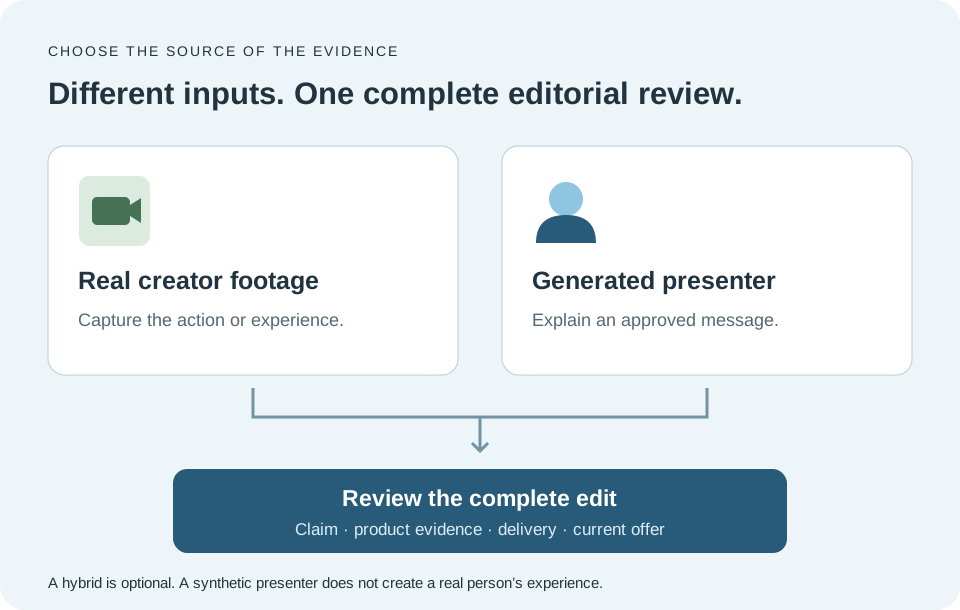
A paid creator does not automatically supply an independent customer review, and a synthetic presenter does not supply personal experience. The script and footage should accurately represent the source of the claim. Choose the production route that can provide the evidence the message requires.
This distinction is useful even before selecting a vendor. If the brief is an actual demonstration, the product needs to be shown performing the action. If it is an explanation, a presenter may be only one possible format. The category label should not determine the creative decision by itself.
What an AI UGC platform can contribute
Arcads documents actor-led generation and related editing workflows, while Creatify documents product-link and asset-based ad creation. These capabilities can help turn an approved message into visual material without recording every presenter segment separately.
The main production benefit to evaluate is controlled reuse: changing an opening, producing another delivery or adapting a supported explanation. The output still needs review for pronunciation, product accuracy and how it fits the final edit. A generated first draft is not automatically a finished campaign asset.
AI production is particularly worth investigating when the script and evidence are already clear. If the team is still deciding what the product can claim, a generator may simply produce polished versions of an unresolved brief. Resolve the substance before expanding the output.
Keep the provider’s capabilities specific. A product may offer actor generation, editing and translation, but each feature can have its own usage rules. Do not assume that a subscription includes unlimited complete ads or that every correction is a simple text edit.
What a human creator platform can contribute
Billo presents a creator marketing workflow connecting brands with real creators. That route is relevant when the campaign needs someone to handle a product, record an action or contribute a human performance and perspective. Confirm the exact deliverables and production terms in the current offer.
A creator can supply details that were not present in the initial script: how the product feels to use, which step needs explanation or what a viewer may find confusing. Those observations can improve the brief as well as the footage. They are a different contribution from having a synthetic presenter read a finished message.
Human production still needs direction and review. A vague brief can produce footage that is difficult to use, and a polished performance can still contain an inaccurate claim. Specify the demonstration, required shots and intended message while leaving room for a natural delivery.
Do not assume every marketplace fee includes the same number of versions, revisions, raw files or uses. Ask for an itemized scope and compare like-for-like deliverables. We did not verify a current public Billo price from its pricing route, which redirected to login during this review.
Compare the same brief, not unrelated price labels
A software subscription may provide capacity for several generation operations, while a creator quote may cover filming and a defined edit. Comparing the two headline amounts without accounting for the work included can lead to a misleading conclusion.
Define a common deliverable: for example, one product explanation with a demonstration, captions, two openings and the required final format. For each route, list what is supplied and what the business must still do. Include briefing, source preparation, selection and finishing.
Record the cost per accepted deliverable after a pilot. Include rejected attempts or a necessary reshoot, but keep the reasons visible. A poor brief should not be mistaken for an inherent weakness in the production category.
Use current offers rather than generic market averages when making the purchase. Creator scope and software usage vary too much for one universal price-per-video figure to settle the decision. A concrete quote and a representative production test are more useful.
The correction process can determine the better fit
List the changes that commonly occur in your campaigns. A new price, a different opening, an updated product shot and a rewritten claim are different revision tasks. Some can be handled in an editor; others require new audio, generation or filming.
In an AI workflow, a script change may require regeneration and another quality review. In a human workflow, a new spoken line may require another recording, while an existing take or a text-card update may be enough for a simpler correction. Avoid assuming that every change in one category is instant and every change in the other requires a full shoot.
Test a realistic correction during evaluation. Ask how the provider or workflow handles it, what it costs and how the replacement is identified. The first successful draft gives only part of the purchasing evidence.
Keep reusable source material where the agreed scope allows it. A good demonstration can support several edits, and an approved presenter segment can remain useful when only the closing card changes. Preserving the right components can reduce work in either production route.
Use human footage when the action is the proof
Some messages depend on showing what actually happens. A product’s assembly, fit, texture, handling or interface behavior may be central to the claim. Real footage can document that action directly, while generated imagery may only illustrate what the action is supposed to look like.
Choose the shot that makes the evidence understandable. A close-up of the relevant mechanism may be more useful than a presenter describing it. If the benefit takes time to demonstrate, give the sequence enough room rather than cutting it into an uninformative montage.
When the message depends on a person’s actual experience, use that person’s supported account. Do not rewrite it into a stronger result simply because the ad would sound more persuasive. Keep the conditions and context that make the statement accurate.
AI tools can still assist with editing, captions or other production tasks around real footage. The choice of a human source does not require every step to be manual. Decide which part needs to be captured and which parts can be assisted.
Use generated material when the explanation is the job
A scripted feature introduction, an objection response or a concise localized explanation may not require a new personal experience. A generated presenter can be a practical way to deliver that material, provided the script and supporting evidence are sound.
Keep the explanation connected to the product. Use an actual screen recording or product shot when it answers the viewer’s question more clearly than a generic background. The presenter should help organize attention rather than occupy the frame without adding information.
Evaluate the delivery in the intended format. A voice that works for a calm explainer may not fit a short ad, and a dramatic opening may be inappropriate for a detailed product walkthrough. Use the real script and final edit during the trial.
Approve one representative version before generating many variations. The production method can make repetition easier, but a large set of weak concepts is still weak creative. The value comes from useful, reviewed variants.
A hybrid workflow can preserve the strengths of both
Begin with real product evidence, then decide whether a generated introduction or explanation helps the viewer understand it. The human footage supplies the action; the generated segment may provide a different opening, language or framing. Keep the relationship between them explicit in the brief.
For a software product, the core might be a screen recording of one task, with a short presenter setup. For a physical product, it might be a filmed demonstration followed by a concise explanation of the feature. The hybrid structure should have a communication purpose, not merely showcase several tools.
Review transitions carefully. Differences in lighting, pacing or voice can make the edit feel disconnected. Use the product action as the organizing thread and keep captions and audio levels consistent enough to follow.
Track the source of each segment and claim. This helps future revisions and avoids implying that a synthetic character personally performed the filmed action. A clear source record also makes it easier to replace only the component that changed.
Choose the source for each part of the ad
| Part | Possible source | Review focus |
|---|---|---|
| Product demonstration | Real captured footage | The action supports the claim |
| Feature introduction | Human or generated presenter | Clear, accurate explanation |
| Personal experience | The actual person’s supported account | Meaning and context preserved |
| Localized narration | Reviewed recording or generated audio | Language and offer remain correct |
| Closing card | Editable design | Current price, destination and next step |
An illustrative division of production roles. It does not assert that either method is always cheaper or more effective.
Measure production and campaign outcomes separately
Production measures include time to approval, cost, correction rounds and accepted assets. Advertising outcomes include the campaign’s response and business result. A workflow can improve the first set without necessarily improving the second.
If you compare campaign performance, record the differences in message, audience, offer and distribution. A human and an AI ad may vary in far more than the presenter source. Avoid attributing every difference to the production method.
Keep conclusions narrow enough to support. One successful campaign can justify using a workflow again for a similar brief; it does not establish a universal winner across products and audiences. Likewise, one poor output may reveal a source or script problem rather than a category-wide limitation.
Use the production record to improve the next cycle. If the human demonstration is consistently valuable and the generated opening saves time, keep that combination. The business does not need to choose a single method for every future video.
Common questions about AI and traditional UGC platforms
Which converts better? We have not run a controlled campaign comparison and do not claim a universal winner. The creative idea, offer, audience and evidence all matter. Evaluate your own campaign while keeping production costs visible.
Is AI always faster? Generation can reduce some recording work, but preparation, retries and review still take time. Human footage can also be reused and re-edited. Compare the actual path to an approved asset, including the correction you expect.
Can AI replace a testimonial? It can present a script, but it does not create a real person’s experience. If that experience is the reason to believe the message, retain the actual supported account.
Should a small business use both? Only when each solves a clear part of the brief. A hybrid workflow can be useful, but additional tools and handoffs also create work. Start with the simplest route that supplies the evidence and presentation you need.
What we would do
Choose human creators for the experience and actions that need to be captured, and evaluate AI production for scripted explanation and deliberate variants. Compare complete, accepted deliverables and the correction process. Use a hybrid when its parts have clear jobs.
Sources & methodology
We reviewed public vendor pages and search results on . We did not run paid hands-on tests or measure ad performance. “Verified” means supported by a linked official source, not independently tested. “Calculated” means arithmetic with stated assumptions. “Reported” means information supplied by the publisher or a third party, with its provenance stated in the article. “Unknown” means not established in this review. “Editorial” identifies our analysis.
- Arcads: official product information ↗
- Creatify: official pricing information ↗
- Billo: official product information ↗
- Billo: creator marketing workflow ↗
- Arcads: generated actor and editing workflows ↗
- Creatify: AI video-ad inputs ↗
Prices are in USD where shown. Confirm billing period, applicable tax, promotions, feature access and usage rules at checkout. Research dates are fixed to this review, not automatically refreshed on deployment.