
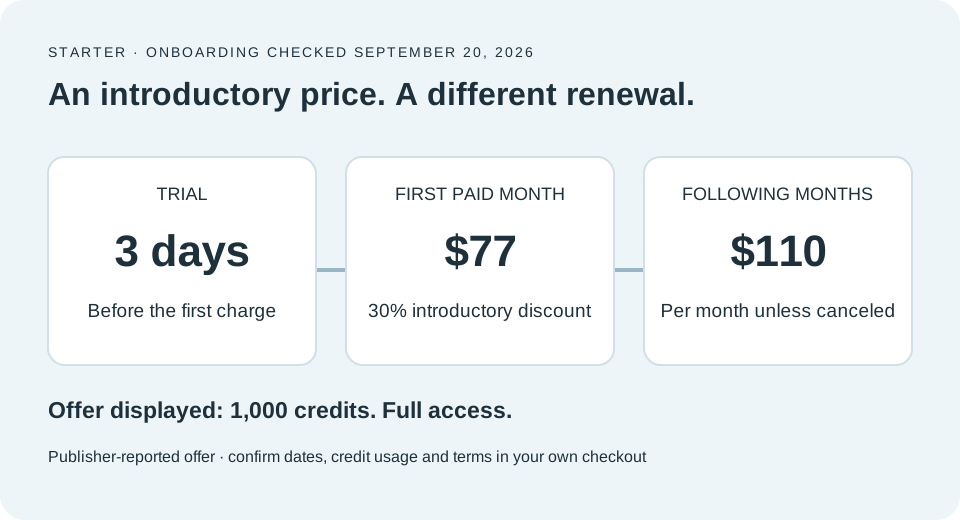
Arcads Starter offer observed September 20, 2026
| Offer detail | What was shown | Evidence |
|---|---|---|
| Trial | 3 days before the first charge; cancel anytime | Publisher-reported onboarding |
| First paid month | $77 · Starter, 30% off | Publisher-reported onboarding |
| Following months | $110/month unless canceled | Publisher-reported onboarding |
| Credits and access | 1,000 credits; “Full access” | Publisher-reported onboarding |
| First charge in the observed session | September 23, 2026 | For the September 20 signup |
| Credit usage and renewal details | Confirm in the same account and offer | Not established by the quoted offer |
The publisher supplied the onboarding wording on September 20. We did not independently complete checkout or run paid renders. The quoted offer does not establish the trial credit allocation, replenishment schedule or a complete feature-entitlement list.
What Arcads costs after the introductory discount
The clearest way to read the offer is as three stages: a three-day trial, a discounted first paid month, then the regular monthly renewal. Do not present $77 as the permanent monthly price. It is the introductory Starter amount in this onboarding session; the following subscription months are $110 each unless you cancel.
The discount arithmetic is straightforward: 30% of $110 is $33, and $110 minus $33 is $77. Across three paid subscription months, the stated charges total $297: $77 plus two renewals of $110. Across twelve paid months, they total $1,287. These are calculations from the reported monthly offer, not an annual-plan quote. They exclude any tax or additional purchases.
A short evaluation and an ongoing production commitment therefore have different budgets. The first paid month can tell you whether the workflow fits. A team adopting the tool should judge its continuing usefulness against $110/month, because the initial $33 saving does not repeat in the wording supplied. Keep the actual offer with your purchase records so the renewal amount is clear to whoever owns the budget.
Calculated subscription charges
| Period | Calculation | Total |
|---|---|---|
| First paid month | $110 × 70% | $77 |
| Three paid months | $77 + $110 + $110 | $297 |
| Twelve paid months | $77 + 11 × $110 | $1,287 |
Assumes the reported offer, uninterrupted monthly renewals and no extra charges. This is not annual billing or a guarantee of future pricing.
The three-day trial and the September 23 charge date
The onboarding message said the account would not be charged until September 23, and that it could be canceled anytime. That date belongs to the signup checked on September 20, 2026. It should not become a fixed promise to everyone reading this page later. Use the date and time shown in your own account when planning a cancellation or purchase decision.
The offer said the first charge after the three days would be $77 for Starter, followed by $110/month unless canceled. A trial is therefore not the same as a permanently free plan. If you only intend to evaluate the product, record the deadline before beginning and retain the cancellation confirmation if you decide against continuing.
Prepare a representative script, approved product assets and a clear acceptance standard before starting. Three days can disappear while you gather materials. Test the task that would prevent adoption first: the pronunciation you need, the product depiction that must remain accurate, or the revision you expect to make repeatedly. Browsing actors alone will not answer those production questions.
What “1,000 credits. Full access.” establishes
The offer explicitly displayed 1,000 credits and “Full access.” That is the allowance and access wording we report for this observed offer. The short phrase does not itemize the available models, exports, seats or custom-actor features. It also does not explain whether the displayed balance is allocated during the trial, at the first payment, or on each renewal. Those details need the account’s own plan and usage screens.
There is a material mismatch with the public help-center material reviewed earlier: its allowance article listed 8,000 credits for Starter and 16,000 for Creator. We do not substitute either of those figures for the 1,000 credits shown in this newer onboarding session. Nor do we infer that a smaller displayed balance necessarily buys less output; a credit-system change could alter both the allowance and consumption, but that has not been established here.
Before estimating how many clips you can make, check the consumption displayed for a specific generation in the same account. Record its model, duration and actor count beside the balance. This resolves the practical capacity question without multiplying a new offer’s credits by potentially different documentation. The price is now concrete; the number of usable deliverables still depends on the operation and its results.
Why we are not converting those credits into a video count
The public usage guide reviewed for this article described selected Talking Actor operations at 800 credits per minute per actor, with duration rounded up. That is useful documentation about those stated operations, but applying it directly to the newly reported 1,000-credit offer would assume the two sources use an equivalent credit system. We have not established that equivalence.
For that reason, this page does not claim that Starter buys one video, ten videos or a particular number of minutes. It also does not divide $77 by a guessed output count to advertise a cost per ad. Both shortcuts would turn the unresolved usage detail into a misleading purchasing conclusion. Ask for the charge on the operation you actually intend to use.
Include the complete job in that check. An actor render can be only one part of an ad that also needs product footage, captions, translation or a second attempt. Define an approved final asset before comparing subscriptions. A balance that covers a first pass may still be insufficient for the revisions needed to publish it.
Budget around approved output and ordinary revisions
Once the account confirms usage, keep a small production log: what you requested, the balance consumed, whether the output was accepted, and the time spent correcting it. Separate a technically successful render from an ad you would publish. Product fidelity, delivery, pronunciation and factual accuracy can each require work even when generation completed normally.
For a simple recurring-month illustration, suppose the $110 subscription supports five approved deliverables with no extra purchases. The subscription allocation is $22 per accepted asset. If it supports ten, the allocation is $11. These are scenarios, not measured Arcads capacity or performance. Editing time and other production expenses would increase the effective cost.
This makes the adoption decision more useful than comparing the first-month discounts of several tools. A workflow that reliably gets the required result approved may justify a higher subscription. Conversely, an attractive trial can still be a poor fit if every output needs a long repair. Use the trial to learn which situation applies to your own brief.
Cancellation, refunds and unused balance are separate questions
“Cancel anytime” describes the ability to stop the subscription; it should not be read as a promise that every previous charge or unused credit will be refunded. Arcads maintains a separate refund policy. Read its current conditions for your situation, particularly the distinction between a subscription refund and reimbursement for a generation problem.
The help-center allowance article also described different rollover rules by tier. Because the newly observed Starter offer has a different displayed balance, confirm the renewal and expiration rules in that offer before relying on an older allowance description. Ask what happens to unused credits, whether extra usage can be purchased, and when cancellation takes effect.
For occasional campaigns, those answers can matter more than a small introductory saving. A business producing one launch this month and nothing next month should know whether retained access or balance requires another charge. A team with weekly deadlines should understand the route for additional capacity before it runs out in the middle of a delivery.
Compare the recurring offer against a matched production brief
Use $110/month as the Arcads baseline when comparing ongoing subscriptions, and show the $77 first month separately. MakeUGC and Creatify publish their own offers, but their credits are not interchangeable with Arcads credits. Match the duration, assets, revision requirement and final export before drawing a value conclusion.
If the Arcads trial demonstrates the workflow you need, the next question is whether the recurring allowance supports your realistic schedule. If it does not, evaluate a different plan or workflow using its actual terms. Keep the choice grounded in accepted output rather than assuming that a larger credit number or a cheaper introduction wins.
What we would do
The September 20 onboarding offer supplies a clear Arcads Starter price: three trial days, $77 for the first paid month, then $110/month unless canceled, with 1,000 credits and “Full access” displayed. Budget at the recurring price and use your own checkout’s billing date. The remaining question is production capacity: reconcile the account’s generation charges and credit-renewal rules before converting that balance into a video count. We would use the trial for a representative asset and revision, then decide whether its approved output justifies the ongoing subscription.
Sources & methodology
We reviewed public vendor pages and search results on . We did not run paid hands-on tests or measure ad performance. “Verified” means supported by a linked official source, not independently tested. “Calculated” means arithmetic with stated assumptions. “Reported” means information supplied by the publisher or a third party, with its provenance stated in the article. “Unknown” means not established in this review. “Editorial” identifies our analysis.
- Arcads: official product information ↗
- Arcads: How Are Credits Counted? ↗
- Arcads: How to Buy More Credits ↗
- Arcads: Refund Policy ↗
Prices are in USD where shown. Confirm billing period, applicable tax, promotions, feature access and usage rules at checkout. Research dates are fixed to this review, not automatically refreshed on deployment.