
Match the tool to the localization job
| Campaign requirement | Candidate | Decision to test |
|---|---|---|
| Existing presenter footage | HeyGen, Rask | Speech, visible presenter and correction workflow |
| Audio dubbing for an edited video | ElevenLabs | Version, editability and how audio returns to the timeline |
| New actor-led ad concepts | Arcads | Local script, delivery and product evidence |
| Translated subtitles and on-screen copy | An editor alongside the localization tool | Editable text, line breaks and aspect ratios |
| Several markets with different offers | A controlled campaign workflow | Version ownership and market approval |
These are workflow candidates, not measured language-quality winners. Confirm the exact language, feature and plan with a representative sample.
Synthesia: create a localized presenter-led campaign from a reusable structure
Start with Synthesia when the campaign is a new presenter-led explanation rather than a recording that must be dubbed. Its marketing workflow supports localized voiceover, on-screen text and captions. Keep the approved product demonstration as the evidence and use the presenter to connect the message across scenes.
Test a representative target-language version before expanding the campaign. Check whether a translated offer fits the frame and whether the product terminology remains consistent in the narration and visible text. A single translation action does not remove the need for a qualified reviewer to approve the final asset.
Separate the reusable scene structure from the market-specific claims. Keep the original product facts fixed, while reviewing examples, currency, availability and the closing action for each market. This makes Synthesia a useful first evaluation for a recurring explanation that needs to stay recognizable across localized versions.
Translate the campaign brief before translating the video
Start with the audience and the action you want them to take. A translated sentence can be accurate while the campaign remains unsuitable for its destination. The product may have a different name, the offer may be unavailable, or the demonstration may show an interface the local customer will never see. Those are brief-level problems; another voice model will not solve them.
Write down the market, language variant, audience, product version, offer and destination page. Include the terms that must remain unchanged and the phrases that can be adapted. Give the reviewer the original purpose of the message, not just a spreadsheet of isolated sentences. Someone who understands why a line exists can suggest a better local version without losing its role in the ad.
Separate a shared proposition from a market-specific execution. A software campaign may keep the promise of saving time while changing the example, currency and screen recording. A physical product campaign may retain the same demonstration but need a different shipping statement. Decide this before generating files so that a local correction does not become an expensive global rebuild.
Keep the brief short enough to use. A page containing the promise, proof, prohibited claims, pronunciation notes and destination is often more actionable than a large brand presentation. Link the brief to every localized project so that the editor and reviewer are checking the same intended message.
Choose between dubbing, presenter localization and new creative
Dubbing is appropriate when the visual story already works and only the spoken language needs to change. A product assembly sequence or an interface demonstration may not need a visible speaker at all. In that case, voice quality, timing and an editable audio handoff matter more than lip synchronization.
Presenter localization adds another constraint: viewers see a person speaking. Evaluate the translated performance as a whole, including the relationship between the voice, face and pacing. A technically synchronized mouth does not guarantee that the delivery sounds persuasive or that the sentence is natural in the target language.
New creative is a different job. If the original opening relies on a local joke, an unfamiliar example or a market-specific objection, translating it may preserve the wrong idea. Write a new opening using the same underlying product evidence. Keep a record of that decision so the campaign report does not label a substantially different concept as a simple language variant.
A mixed workflow is often sensible: reuse the demonstration, rewrite the hook and regenerate the presenter segment. The selection criterion is the amount of approved material you can preserve while making the message appropriate. Do not force every asset through a full-video translation process simply because the tool offers one.
HeyGen: compare translation modes using the real source material
HeyGen documents separate credit rates for Speed translation, Precision translation and translation without lip sync. That makes the selected mode part of the budget, not a minor setting. Its current guide lists six, ten and four credits per minute respectively. Check the plan and the mode together before projecting the cost of a campaign.
Use a representative source rather than a clean generic introduction. Include the product name, a number and the most difficult sentence in the actual ad. Ask a qualified speaker to assess meaning, pronunciation and naturalness. If a correction is necessary, complete the correction and export again; the first render alone does not reveal the operational fit.
Presenter footage needs a visual review as well as a language review. Check difficult cuts, changes in camera angle and the closing frame. Keep the original project available so a problem can be solved through an edit rather than repeated full generations. Record the mode used for each approved sample so the later production run can reproduce the choice.
Rask and ElevenLabs: distinguish video localization from an audio handoff
Rask presents video translation with voice cloning and lip-sync capabilities. It belongs on the shortlist for an existing-video workflow. Verify which parts of the job the current plan covers and try a correction in the actual project. The practical question is whether your reviewer can get a specific phrase fixed without making the rest of the approved work difficult to preserve.
ElevenLabs requires a particularly careful version distinction. Its current documentation describes automatic Dubbing v2 without an in-app editor, while the older v1 Dubbing Studio remains an editable workflow in maintenance mode. Enterprise API editing is a separate capability. Do not buy on the assumption that every dubbed result can be opened and corrected in the same studio.
ElevenLabs Dubbing also does not itself provide lip synchronization. It can be relevant when the output you need is translated audio, but a visible presenter may require another production step. Identify who places the audio back into the video, adjusts the timing and signs off the export. An excellent audio result is only one component of a complete campaign asset.
When comparing these routes, write down the handoff explicitly: source video in, editable project or audio out, final export produced where. This makes the comparison more useful than a broad list of supported languages. It exposes extra editing work before the team commits to a deadline.
Arcads: use fresh actor-led variants when the message needs adaptation
Arcads documents actor-led generation, translation and editing capabilities, including workflows for reusable production steps. It is worth evaluating when localization involves creating new ad material rather than only changing the audio of an existing master. The local script should be approved before you expand the number of actors or versions.
Choose a delivery that suits the message and audience. A direct product explanation and a casual objection-handling ad may need different pacing. Ask the reviewer whether the line sounds like something a person would naturally say in that setting, rather than whether it is a grammatically correct translation of the original.
Preserve product evidence across variants. If the ad promises a particular result, the demonstration should still show the relevant feature or action. An actor change does not create new proof. Use the actual product recording where it communicates more clearly than generated illustrative material, and keep the claim consistent with the destination page.
Evaluate one complete localized ad before building a large matrix. Check the script, performance, caption layout, product shot and offer together. If the first example exposes a brief problem, fix that upstream. Multiplying an unresolved issue across languages only creates more files to repair.
Build a variant matrix that includes more than language
Treat each deliverable as a combination of concept, market, language, offer and placement. Language alone is not a sufficient identifier. Two markets may share a language while using different currencies or landing pages; one market may require several language variants. A clear matrix prevents an editor from selecting the wrong closing card simply because the narration sounds familiar.
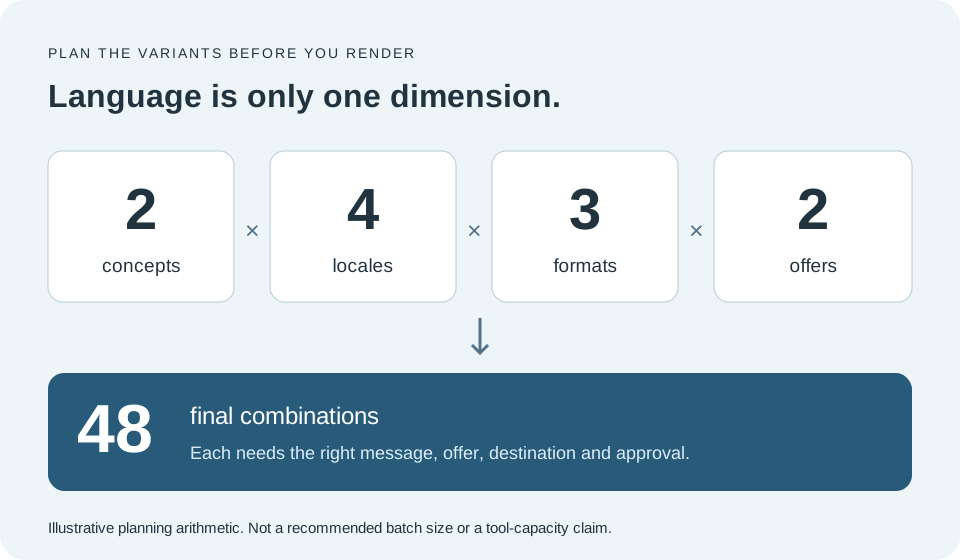
For example, two concepts multiplied by four locales, three aspect ratios and two offer versions create forty-eight final combinations. That is an illustrative planning calculation, not a recommended campaign size. The point is to see the workload before generation. Some combinations may be unnecessary, and eliminating them is often more valuable than rendering them faster.
Mark which elements can be shared. A demonstration may remain the same across two locales while the voice and closing card change. A square and vertical version may share narration but require different caption placement. Reuse approved components where appropriate, while keeping a distinct approval state for each final export.
Give every asset a stable identifier and a human-readable description. A file name such as ConceptB_France_French_Vertical_Offer2_v03 conveys useful information, but the tracker should also hold the destination, reviewer and approval date. Do not rely on filenames alone to store every campaign decision.
Example localization matrix fields
| Field | Why it belongs in the record |
|---|---|
| Concept and source version | Connect the localized asset to the correct master |
| Market and language variant | Avoid confusing language with destination |
| Offer and landing page | Keep the promise consistent after the click |
| Aspect ratio and duration | Identify the actual placement deliverable |
| Reviewer and status | Separate generated from approved |
| Final export and superseded version | Prevent accidental use of an old asset |
A proposed production record. The forty-eight-asset example is 2 × 4 × 3 × 2, not a tool capacity claim.
Keep a glossary, but allow the local copy to sound natural
A glossary should resolve recurring decisions: product names, feature names, preferred translations and pronunciation. Include context and an example where a term is ambiguous. A reviewer should not have to rediscover the approved name of a feature in every new video.
Do not turn the glossary into a requirement for word-for-word translation. Marketing copy often needs a different sentence structure to sound natural. Preserve the claim and the intended action while allowing the reviewer to rewrite the phrasing. If the local line becomes longer, solve the timing deliberately through a shorter formulation or an adjusted edit.
Numbers deserve a separate pass. Check currency, decimal notation, measurement units, dates and the period covered by a price. A monthly subscription and an annual total should not become interchangeable during adaptation. Compare the video with the actual destination offer, not just with the source-language script.
Store the approved local script after review. Reusing an old machine draft for a later revision can silently reintroduce a correction that the reviewer already made. The approved wording, pronunciation decisions and final audio should remain connected to the asset record.
Review the complete frame, not only the translated narration
Visible text is part of the message. Inspect the headline, product interface, captions, demonstration labels and closing card. A translated voice over an untranslated pricing panel can leave the viewer with two different versions of the offer. Create a list of every text-bearing element before deciding how much of the master can be reused.
Text expansion can change a layout even when the meaning is correct. Check the longest headline and caption lines in the final aspect ratio. Rebalance the frame rather than shrinking every line until it is technically inside the box. The viewer still needs time to read and see the product.
Watch with sound off, listen without the picture, and then review the combined export. These passes answer different questions: whether the visual message stands alone, whether the voice is understandable, and whether the two agree. Include the first and last frames, which are easy to overlook when attention is focused on the translated speech.
If the localized video changes the offer or example, verify the accompanying ad copy and destination as well. The approval unit should be the complete customer-facing combination. An accurate video paired with an old headline can still communicate the wrong promise.
Budget for approved variants and correction rounds
Separate platform spend, reviewer time and finishing work. A generation allowance covers only part of production. The useful cost measure is the total effort required to obtain an approved deliverable, including unusable attempts and ordinary revisions. Keep this distinct from media spend and campaign performance.
Use a small pilot to establish your own planning range. Record the number of submitted variants, accepted variants, correction rounds and review minutes. If ten generated files produce six approved assets, divide the relevant production cost by six rather than ten. This is a bookkeeping method, not a predicted acceptance rate for any tool.
Credit schedules also differ by feature. A voice-only translation, a lip-synced video and a newly generated actor segment may consume different units. Compare a defined workload using the documented feature costs and actual plan allowance. Do not compare two products merely because both call their billing units credits.
Leave capacity for a likely change, such as an updated offer or corrected feature name. A budget that consumes the entire allowance on the first pass can force an upgrade for a small revision. Ask how resets, unused balances and additional usage work under the current subscription before setting the production calendar.
Make approval roles and change propagation explicit
Assign one person to the source claim, one to local language quality and one to final production approval; a small team may combine roles, but the responsibilities still need names. The language reviewer should know whether they are approving wording only or the complete exported video. A script approval does not establish that the generated voice pronounced it correctly.
When a master changes, identify the affected components before reopening every file. A new shipping line may affect the script, narration, subtitles and closing card in certain markets. A corrected product shot may affect every aspect ratio without changing the audio. A dependency record makes that work visible.
Mark superseded assets clearly and keep the approved replacement easy to find. Do not overwrite a final file while leaving its old approval attached. The reviewer needs to know which version they saw, and the person publishing needs one unambiguous current export.
For recurring campaigns, finish each cycle by updating the glossary and brief with the decisions that proved useful. The goal is not an elaborate administration system. It is to avoid paying for the same correction in every market and every production round.
Run a pilot that answers a purchasing decision
Choose one important market and one representative asset. Include the elements most likely to cause work: a product name, an offer, visible text and a real demonstration. Use the same approved source and evaluation criteria for each shortlisted workflow. A generic greeting clip will not reveal whether the tool fits the campaign.
Ask the reviewer to log specific defects and required changes rather than give only an overall score. Separate incorrect meaning, unnatural wording, pronunciation, timing and visual issues. Then perform the correction round. Measure how much work remains outside the product and whether the final result is acceptable.
Expand only after the pilot passes. Add another language or format to see whether the process remains manageable. If the second version exposes a layout problem, improve the master before producing the full matrix. Scaling a stable process is more useful than demonstrating a large batch of unreviewed files.
Keep the purchasing conclusion narrow and evidence-based: this workflow handled this source, these languages and this correction process under this plan. That is enough to make a practical decision. It does not require claiming that one tool has the best translation quality in every language.
Common questions about multilingual video marketing
Can one English video work everywhere? Sometimes its demonstration and core proposition can be reused, but check the local offer, references, visible text and destination. Treat reuse as an editorial decision. A campaign that depends on a local joke or unfamiliar example may need a new concept rather than a literal translation.
Do you need lip sync? Only when the visual presentation benefits from it. For screen recordings or product footage, a clear localized voiceover may be sufficient. For a visible presenter, compare the whole result and the additional production cost. Lip synchronization does not replace language review.
Can automatic translation replace a local reviewer? It can produce a draft, but the team still needs someone qualified to judge the final message. Pay particular attention to product claims, prices and language that sounds unnatural despite being grammatically plausible. Define who can approve those decisions before production begins.
How should you compare results between markets? Keep production efficiency separate from advertising outcomes. Different audiences, offers, budgets and destinations can affect campaign performance. Record which creative elements changed so a stronger result is not automatically attributed to the translation tool.
What we would do
Choose the localization workflow around the asset and the market. HeyGen and Rask are candidates for existing presenter video, ElevenLabs for a deliberate audio-dubbing handoff, and Arcads for newly authored actor-led variants. Approve one complete localized campaign asset, document the corrections and then expand the matrix.
Sources & methodology
We reviewed public vendor pages and search results on . We did not run paid hands-on tests or measure ad performance. “Verified” means supported by a linked official source, not independently tested. “Calculated” means arithmetic with stated assumptions. “Reported” means information supplied by the publisher or a third party, with its provenance stated in the article. “Unknown” means not established in this review. “Editorial” identifies our analysis.
- Synthesia: official product information ↗
- HeyGen: official pricing information ↗
- Rask: official product information ↗
- ElevenLabs: official product information ↗
- Arcads: official product information ↗
- HeyGen: credit costs by translation mode ↗
- ElevenLabs: dubbing versions and editing limitations ↗
- Rask: video translation workflow ↗
- Arcads: platform capabilities and workflows ↗
Prices are in USD where shown. Confirm billing period, applicable tax, promotions, feature access and usage rules at checkout. Research dates are fixed to this review, not automatically refreshed on deployment.